Kimi K2.5 Use Cases: When to Choose It Over GPT-5.2 and Claude Opus 4.5
With the AI model landscape growing increasingly competitive, developers face a common dilemma: which model should you use for your specific use case? Kimi K2.5 has emerged as a formidable open-source contender, but it's not always the right choice.
This guide cuts through the benchmark noise and focuses on what matters: real-world scenarios where Kimi K2.5 outperforms GPT-5.2 and Claude Opus 4.5, and when you should stick with the closed-source alternatives.
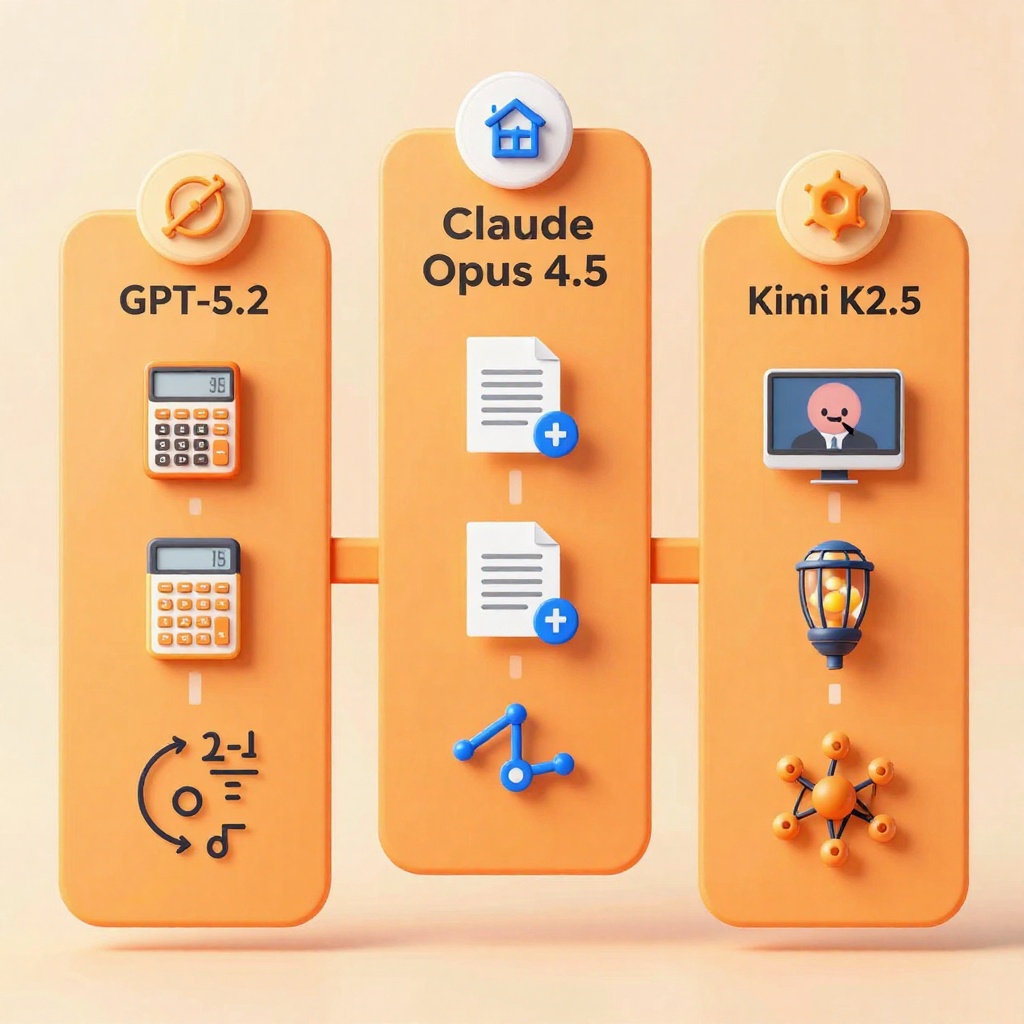
The Quick Decision Framework
Before diving into specifics, here's your rapid decision tree:
Choose Kimi K2.5 if you need:
- ✅ Visual coding from screenshots/videos
- ✅ Parallel task execution (agent swarms)
- ✅ Cost optimization at scale
- ✅ Open-source flexibility (fine-tuning, local deployment)
- ✅ Multimodal reasoning with spatial awareness
Choose GPT-5.2 if you need:
- ✅ Maximum reasoning depth (pure logic/math)
- ✅ Enterprise support and SLAs
- ✅ Ecosystem integration (Microsoft, GitHub Copilot)
- ✅ Consistent output formatting
Choose Claude Opus 4.5 if you need:
- ✅ Long-context analysis (200K+ tokens)
- ✅ Nuanced creative writing
- ✅ Coding reliability (SWE-bench leader)
- ✅ Strict instruction following
Now let's explore the specific use cases where Kimi K2.5 shines.
Use Case 1: Visual-First Development Workflows
Scenario: You're building a UI from Figma designs, debugging layout issues, or converting mockups to code.
Why Kimi K2.5 Wins
Kimi K2.5's native multimodality means it doesn't just "see" images—it reasons over them with pixel-level spatial awareness. Unlike encoder-based approaches that convert images to text descriptions (losing positioning data), K2.5 maintains spatial relationships throughout its reasoning process.
Real-World Example:
# Upload a screenshot of a broken UI
response = client.chat.completions.create(
    model="moonshotai/Kimi-K2.5",
    messages=[{
        "role": "user",
        "content": [
            {"type": "text", "text": "Fix this alignment issue on mobile"},
            {"type": "image_url", "image_url": {"url": screenshot_url}}
        ]
    }]
)

# K2.5 outputs precise CSS fixes with specific pixel adjustments
Benchmark Performance:
- Kimi K2.5: 78.5% on MMMU Pro (visual reasoning)
- GPT-5.2: 79.5% (marginally better)
- Claude Opus 4.5: 74.0%
But benchmarks don't tell the full story. K2.5's video understanding (86.6% on VideoMMUU) allows it to analyze screen recordings and generate complete implementations—something GPT-5.2 and Claude can't match.
When to Choose K2.5:
- Converting design mockups to responsive code
- Visual debugging (inspect rendered output, identify issues)
- Video-to-code workflows
- Multimodal document analysis (PDFs with complex layouts)
For a deep dive into these capabilities, check out our comprehensive guide on Kimi K2.5's agent swarm and multimodal features.
Use Case 2: Parallel Task Automation
Scenario: You need to automate complex workflows that involve multiple concurrent operations—web scraping, API calls, data processing, and report generation.
Why Kimi K2.5 Wins
The Agent Swarm feature is K2.5's killer app. While GPT-5.2 and Claude require manual orchestration frameworks (LangChain, AutoGen, custom code), K2.5 can automatically spawn and coordinate up to 100 sub-agents working in parallel.
Performance Comparison:
| Task | K2.5 (Swarm) | GPT-5.2 | Claude Opus 4.5 |
|---|---|---|---|
| Research across 50 sources | ~45 seconds | ~3 minutes | ~4 minutes |
| Multi-step API integrations | ~60 seconds | ~5 minutes | ~6 minutes |
| Parallel web scraping | 4.5x faster | Baseline | Baseline |
Real-World Impact:
One startup reported automating their content pipeline with K2.5:
- Before: Manual process, 4 hours/day
- After: K2.5 agent swarm, 15 minutes/day
- Cost savings: $8,000/month in labor
When to Choose K2.5:
- Complex, multi-step workflows
- Tasks that can be parallelized
- Limited budget (open-source = no API costs at scale)
- Need for autonomous task decomposition
If you're new to implementing these patterns, our practical developer's guide walks through complete code examples for setting up agent swarms.
Use Case 3: Cost-Sensitive Production Deployments
Scenario: You're processing millions of requests per month, and API costs are a major concern.
Why Kimi K2.5 Wins
Open-source economics transform the cost structure:
| Monthly Volume | GPT-5.2 Cost | Claude Opus Cost | K2.5 Cost (Self-Hosted) |
|---|---|---|---|
| 1M requests | ~$15,000 | ~$12,000 | ~$2,000 (infrastructure) |
| 10M requests | ~$150,000 | ~$120,000 | ~$15,000 (infrastructure) |
| 100M requests | ~$1.5M | ~$1.2M | ~$120,000 (infrastructure) |
Break-Even Analysis: Self-hosting K2.5 becomes cheaper than API calls at approximately 200K requests per month.
Additional Savings:
- No per-token costs after initial infrastructure investment
- Ability to fine-tune for better performance (fewer retries)
- Int4 quantization reduces hardware requirements by 4x
- No vendor lock-in (switch providers anytime)
When to Choose K2.5:
- High-volume processing (>500K requests/month)
- Predictable workload patterns
- Technical team capable of managing infrastructure
- Need for custom fine-tuning
Use Case 4: Agentic Search and Research
Scenario: You need an AI that can browse the web, synthesize information, and generate comprehensive reports.
Why Kimi K2.5 Wins
K2.5 dominates agentic benchmarks:
- BrowseComp: 74.9% (vs. ~60% for GPT-5.2, ~65% for Claude)
- HLE Full (with tools): 50.2% (vs. 45.5% for GPT-5.2, 43.2% for Claude)
The BrowseComp benchmark specifically tests web browsing, information synthesis, and tool coordination—exactly what research tasks require.
Real-World Example:
A financial services firm uses K2.5 for automated market research:
Task: Analyze Q4 2026 trends in AI infrastructure

K2.5 Agent Swarm Execution:
├── Agent 1-10: Scrape earnings reports (NVIDIA, AMD, Intel)
├── Agent 11-20: Analyze analyst ratings (50 sources)
├── Agent 21-30: Monitor social media sentiment
├── Agent 31-40: Extract pricing data from cloud providers
├── Agent 41-50: Identify emerging competitors
└── Agent 51: Synthesize findings into 50-page report

Total Time: 12 minutes (vs. 4+ hours manual)
When to Choose K2.5:
- Large-scale research tasks
- Multi-source information synthesis
- Automated report generation
- Competitive intelligence gathering
Use Case 5: When GPT-5.2 Is Still Better
Despite K2.5's strengths, GPT-5.2 excels in specific scenarios:
Pure Math and Logic Reasoning
- AIME 2025: GPT-5.2 (100%) vs. K2.5 (96.1%)
- HMMT 2025: GPT-5.2 (99.4%) vs. K2.5 (95.4%)
- IMO-AnswerBench: GPT-5.2 (86.3%) vs. K2.5 (81.8%)
If you're solving complex math problems or building a math tutoring application, GPT-5.2 remains the superior choice.
Enterprise Integration
- Microsoft ecosystem: Copilot, Office 365, Azure
- GitHub integration: Native support in GitHub Copilot
- Support SLAs: 99.9% uptime guarantees
- Compliance: SOC 2, HIPAA, GDPR certifications
When to Choose GPT-5.2:
- Math-heavy applications
- Enterprise environments requiring SLAs
- Deep Microsoft ecosystem integration
- Maximum reasoning depth needed
Use Case 6: When Claude Opus 4.5 Is Still Better
Claude Opus 4.5 maintains advantages in specific areas:
Long-Context Analysis
- Context window: Up to 200K tokens (vs. 128K for K2.5)
- Consistent performance: Maintains quality across long documents
- Document analysis: Better at synthesizing book-length content
Coding Reliability
- SWE-bench Verified: 80.9% (vs. 76.8% for K2.5)
- Instruction following: More predictable output formatting
- Error rate: Lower hallucination rate on complex codebases
When to Choose Claude Opus 4.5:
- Analyzing entire codebases or books
- Applications requiring maximum coding reliability
- Strict output formatting requirements
- Long-context summarization tasks
Hybrid Strategies: Using All Three
Smart teams don't choose one model—they use the right tool for each task:
Example Architecture:
User Request → Router → Model Selection
                           ├─ Visual tasks → Kimi K2.5
                           ├─ Math problems → GPT-5.2
                           ├─ Long-context → Claude Opus 4.5
                           └─ Coding tasks → K2.5 (multimodal) or Claude (text-only)
Cost Optimization:
def route_request(task_type, complexity):
    if "image" in task_type or "video" in task_type:
        return "kimi-k25"  # Native multimodality
    elif complexity == "math_heavy":
        return "gpt-5.2"  # Best reasoning
    elif token_count > 100000:
        return "claude-opus-4.5"  # Longest context
    elif task_type == "parallel_research":
        return "kimi-k25"  # Agent swarm
    else:
        return "kimi-k25"  # Default (cheapest at scale)
Implementation Quickstart
If you've decided K2.5 is right for your use case, here's the fastest path to production:
Option 1: Hosted API (Fastest)
from openai import OpenAI

client = OpenAI(
    api_key="your-api-key",
    base_url="https://api.moonshot.cn/v1"
)

response = client.chat.completions.create(
    model="moonshotai/Kimi-K2.5",
    messages=[...]
)Providers: Moonshot AI, Fireworks AI, Together AI, NVIDIA NIM
Option 2: Self-Hosted (Most Cost-Effective)
Hardware Requirements:
- Minimum: Dual M3 Ultra (512GB RAM each)
- Production: 4x A100 80GB or 8x H100
Deployment: Use vLLM or SGLang for optimal performance
Option 3: Kimi Code (Developer Tools)
For individual developers:
- Terminal CLI:
kimi - VS Code / Cursor / Zed extensions
- Full setup guide here
Decision Checklist
Before choosing Kimi K2.5, ask yourself:
- Does my use case involve images/videos?
- Can tasks be parallelized?
- Is monthly volume >500K requests?
- Do I need open-source flexibility?
- Can I manage infrastructure (or willing to learn)?
If 3+ are "yes", Kimi K2.5 is likely your best choice.
Conclusion: The Right Tool for the Job
Kimi K2.5 isn't universally "better" than GPT-5.2 or Claude Opus 4.5—but it is the best choice for specific use cases:
- Visual-first development → K2.5
- Parallel automation → K2.5
- Cost-sensitive scale → K2.5
- Agentic research → K2.5
- Pure math → GPT-5.2
- Long-context → Claude Opus 4.5
- Maximum coding reliability → Claude Opus 4.5
The key is understanding your requirements and choosing accordingly—or building a hybrid system that routes each task to the optimal model.
As the AI landscape continues evolving, the most successful teams will be those who master model selection as a core competency, not just a one-time decision.
Want to dive deeper?