The Future of Agentic AI: Where Kimi K2.5 Takes Us
The release of Kimi K2.5 isn't just another model launch—it's a milestone that signals where agentic AI is heading. While most coverage focuses on benchmarks and feature comparisons, the deeper story is about architectural paradigms that will define the next phase of AI development.
K2.5 proves that open-source AI can match—and sometimes exceed—closed-source giants. But more importantly, it demonstrates that the future isn't about bigger models or more parameters. It's about coordination, multimodality, and parallel execution.
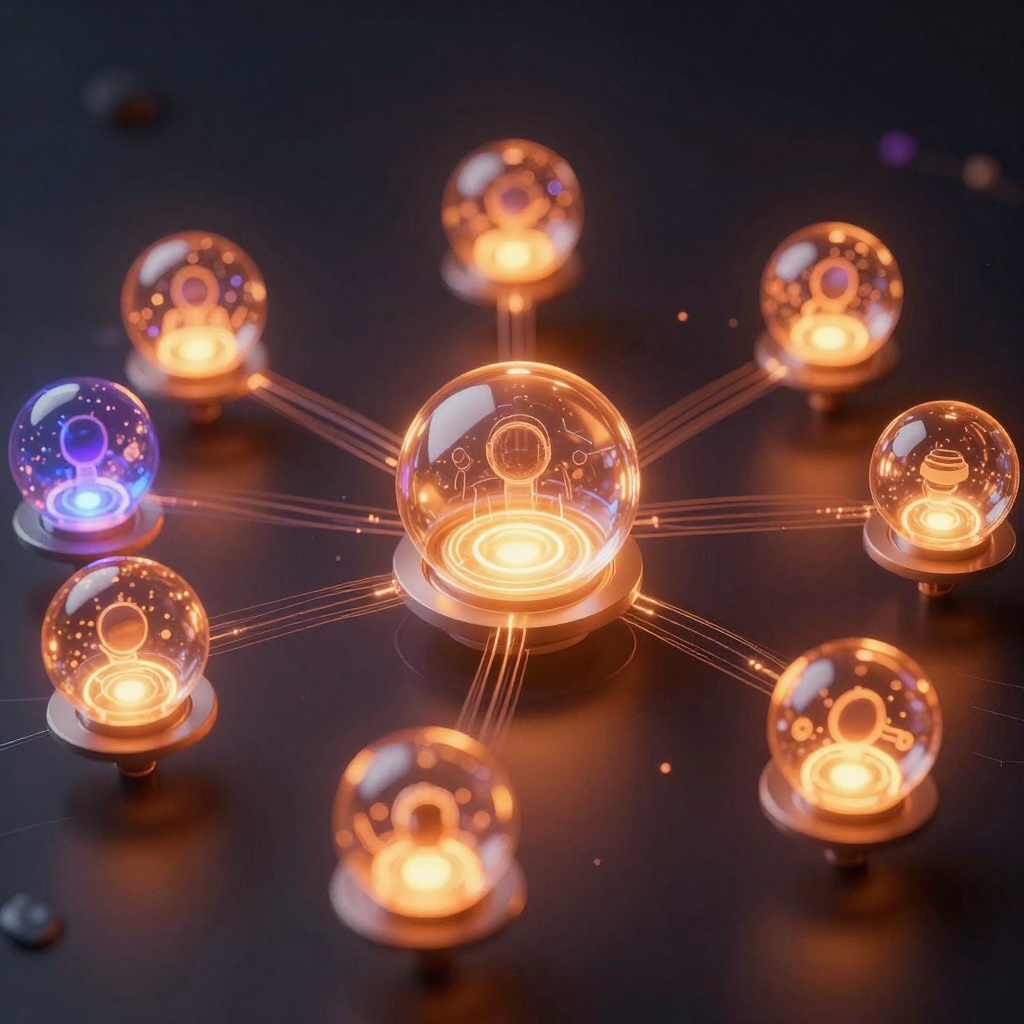
The Paradigm Shift: From Monolithic to Swarm Intelligence
For the past two years, AI development has followed a predictable pattern: build bigger models, train on more data, push parameters higher. GPT-3, GPT-4, GPT-5. Claude, Claude 2, Claude 3. Each iteration followed the same playbook.
Kimi K2.5 breaks this pattern. Its innovations aren't just incremental improvements—they're a fundamental rethinking of how AI systems should work.
The Three Pillars of Next-Gen AI
1. Native Multimodality as Default
Most models treat vision as an add-on: text model + vision encoder. K2.5 treats multimodality as foundational, trained on 15 trillion mixed visual and text tokens from the ground up.
This isn't just technical nuance—it changes what AI can natively do:
- Reason across video frames without temporal degradation
- Maintain spatial awareness while generating code
- Understand diagrams as visual structures, not image descriptions
- Debug by "seeing" rendered output, not parsing error logs
As we explored in our architecture deep-dive, this native multimodality gives K2.5 capabilities that encoder-based approaches simply can't match.
2. Agent Swarm Over Single Models
The breakthrough isn't just that K2.5 can coordinate 100 sub-agents—it's that it does so automatically, without predefined workflows or manual orchestration.
This matters because:
- Real-world tasks are parallel, not sequential
- Single models hit cognitive limits on complex problems
- Swarm architecture scales horizontally, not vertically
- Coordination becomes a learned behavior, not engineered logic
3. Open Source as Competitive Advantage
K2.5 proves that open-source isn't just about cost—it's about ecosystem velocity. While closed-source models operate in secrecy, the open-source community can:
- Fine-tune for specific use cases
- Audit for safety and bias
- Innovate on top of base architectures
- Deploy without vendor lock-in
The result: faster iteration, more diverse applications, and rapid problem-solving that closed-source labs can't match.
What This Means for the AI Landscape
The Collapse of the "Open-Source Gap"
For years, conventional wisdom held that open-source models would always lag behind closed-source counterparts. K2.5 demolishes this thesis.
On agentic benchmarks—arguably the most important frontier for practical AI—K2.5 doesn't just compete; it leads:
- BrowseComp: 74.9% (vs. ~60-65% for closed models)
- HLE with tools: 50.2% (vs. 43-45% for closed models)
This isn't an incremental catch-up—it's overtaking on metrics that matter most for real-world applications.
New Competitive Dynamics
The AI competitive landscape is fragmenting into three distinct approaches:
| Player | Strategy | Strength | Vulnerability |
|---|---|---|---|
| OpenAI | Monolithic scale | Pure reasoning, ecosystem integration | High costs, limited transparency |
| Anthropic | Safety-first reliability | Long context, instruction following | Slower iteration, closed development |
| Moonshot (K2.5) | Open agentic intelligence | Parallel execution, native multimodality | Hardware requirements, fragmentation risk |
| Meta (Llama) | Mass democratization | Broad accessibility, licensing | Lagging on agentic capabilities |
| DeepSeek | Cost leadership | Extreme efficiency | Limited multimodality |
K2.5's success suggests specialization beats generalization. Instead of trying to be the best at everything, Moonshot focused on agentic use cases—and carved out a winning position.
For practical guidance on choosing between these models, see our comparison framework.
The Investment Implications
M&A and Consolidation Wave Coming
K2.5's success makes Moonshot AI an acquisition target. Potential acquirers include:
Cloud Hyperscalers:
- Alibaba (already an investor) would gain AI differentiation vs. AWS/Azure
- Google could integrate K2.5 into Cloud AI, challenging OpenAI's Microsoft partnership
- Microsoft might acquire as hedge against OpenAI dependence
Enterprise Software Giants:
- Salesforce could revolutionize Agentforce with swarm capabilities
- ServiceNow could build autonomous workflow automation
- Oracle could enhance database-integrated AI
Chip Manufacturers:
- NVIDIA could bundle K2.5 with enterprise GPU deployments
- AMD could gain AI software stack to complement hardware
Valuation Implications
If OpenAI is worth $80B+ (based on GPT-4/5 capabilities), and K2.5 matches or exceeds performance on key agentic metrics, Moonshot AI's potential valuation is underpriced relative to closed-source peers.
The open-source nature is a feature, not a bug: it means faster iteration, broader adoption, and ecosystem effects that closed models can't replicate.
Predictive Timeline:
- 2026 Q2: Major cloud partnership announcement
- 2026 Q3: Enterprise-grade agent swarm platform launch
- 2026 Q4: Acquisition talks or $5B+ funding round
- 2027: K2.5 architecture becomes industry standard for agentic AI
Technical Trends: What Comes Next
Beyond 100 Sub-Agents
K2.5's current 100-sub-agent limit is a technical constraint, not a fundamental ceiling. Future iterations will likely:
- Scale to 1,000+ sub-agents: Hierarchical swarms with command structures
- Specialized agent types: Dedicated agents for search, analysis, synthesis, validation
- Cross-instance coordination: Multiple K2.5 instances coordinating across organizations
- Human-in-the-loop patterns: Agents that know when to request human intervention
From Language to Multimodal Reasoning
K2.5's native multimodality points toward post-language AI:
- Direct visual reasoning: No intermediate text conversion
- Cross-modal inference: Learning from video that improves text reasoning
- Sensor fusion: Integrating images, video, audio, and text seamlessly
- Physical world interaction: Robots that use visual reasoning for manipulation
The competitive advantage will shift from "best language model" to "best multimodal reasoner."
The Quantization Revolution
K2.5's INT4 quantization (4x smaller, minimal performance loss) signals a broader trend:
- Edge deployment: Running swarms on laptops, not just data centers
- Mobile agents: Smartphones with local agentic AI
- Cost democratization: $1,000 hardware sufficient for production use cases
- Energy efficiency: Reducing AI's environmental impact
Enterprise Adoption Patterns
From Pilot to Production
K2.5 enables enterprise AI use cases that were previously impractical:
Before K2.5:
Manual Process → Weeks
Single-Agent AI → Days (limited reliability)
Closed-Source API → Expensive at scale
After K2.5:
Agent Swarm (100 parallel) → Hours
Self-Hosted → Predictable costs
Open-Source → Full control & customization
Our developer guide covers implementation strategies, but the enterprise implications are broader:
New Use Cases Unlocked:
- Automated competitive intelligence (monitor 100+ sources simultaneously)
- Multi-document analysis (legal discovery, financial research)
- Automated QA testing (100 parallel browser sessions)
- Content personalization at scale (individualized campaigns for millions)
The Build vs. Buy Equation
K2.5 changes enterprise AI economics:
| Scenario | Closed-Source (Annual) | K2.5 Self-Hosted (Annual) |
|---|---|---|
| 1M requests | $150,000 | $15,000 (infrastructure) |
| 10M requests | $1.5M | $120,000 (infrastructure) |
| 100M requests | $15M | $1M (infrastructure) |
Break-even: ~200K requests/month
For enterprises processing millions of AI interactions annually, self-hosting K2.5 isn't just cost-effective—it's strategic independence from vendor pricing and roadmaps.
The Open-Source Ecosystem Effect
Commodity Foundation, Innovation at Edges
K2.5 follows the Llama pattern: powerful open-source foundation with innovation happening at the application layer. This creates:
For End Users:
- More specialized tools (fine-tuned for specific industries)
- Lower costs (competition among service providers)
- Faster innovation (no single company as bottleneck)
For Developers:
- Ability to fine-tune for proprietary use cases
- No usage restrictions or rate limits
- Full control over data privacy
- Freedom to switch providers
For the Industry:
- Reduced AI monopolization
- More diverse ecosystem
- Faster safety research (open code = better auditing)
- Global accessibility (not limited by export controls)
The China Factor
Moonshot AI's success is part of a broader trend: Chinese AI labs competing effectively with US-based giants. K2.5, DeepSeek, Qwen—all demonstrate that AI innovation is becoming multipolar.
Implications:
- Geopolitical: AI as another arena for US-China tech competition
- Market: Chinese models may dominate Global South markets (price-sensitive)
- Talent: Brain drain from US to Chinese AI companies
- Regulation: Fragmented global AI governance (different rules in different regions)
Risks and Challenges
Technical Risks
Swarm Coordination Failure:
- What happens when sub-agents conflict?
- How do you debug 100 parallel decision streams?
- Can you guarantee determinism?
MoE Complexity:
- 1T parameters with 32B active means complex routing
- Debugging which experts fired for which decisions
- Performance variability across hardware
Quantization Trade-offs:
- INT4 improves speed but may increase error rates
- Edge cases where quantization fails unpredictably
- Difficult to test all quantization scenarios
Market Risks
Fragmentation:
- Too many open-source models diluting ecosystem focus
- Compatibility issues between fine-tunes
- Support and maintenance challenges
Economic Sustainability:
- Can open-source models fund continued development?
- Will talent leave open-source for closed-source salaries?
- Will foundation model training become too expensive?
Safety Concerns:
- Agent swarms harder to control than single models
- Open-source makes dangerous capabilities accessible
- harder to deploy safety guardrails across ecosystem
Predictions for 2026-2027
Near-Term (2026)
Q2 2026:
- Major cloud providers (Azure, GCP) add K2.5 to their AI marketplaces
- First enterprise deployments of K2.5 agent swarms in production
- Competitive models from Meta, DeepSeek add agent swarm features
- K2.5 fine-tunes emerge for legal, finance, healthcare verticals
Q3 2026:
- K2.5-inspired architectures become industry standard
- "Agent swarm" becomes standard feature, not differentiator
- Focus shifts to coordination quality, not just swarm size
- First security incidents involving malicious agent swarms
Q4 2026:
- K2.6 or equivalent announcement with 1,000+ sub-agent capability
- Consolidation: acquisition or major partnership for Moonshot AI
- Regulatory scrutiny of agent swarms (automation displacement concerns)
- Open-source vs closed-source debate intensifies
Medium-Term (2027)
Agentic AI Becomes Table Stakes:
- No serious AI platform without swarm capabilities
- User expectations shift from "smart chatbot" to "autonomous agent"
- Benchmarking moves from reasoning to execution reliability
Multimodality Native:
- New models trained natively multimodal from inception
- Text-only models viewed as legacy technology
- Cross-modal reasoning becomes core competitive differentiator
Economic Realignment:
- API-based AI economics collapse (competition drives prices to zero)
- Value shifts to applications, not foundation models
- Infrastructure providers (NVIDIA, cloud providers) capture most value
The Strategic Question: What Should You Do?
For Enterprises
Start Experimenting Now:
- Try K2.5 on Moonshot's platform for low-risk pilot
- Identify 2-3 high-volume use cases where agent swarms could help
- Calculate your break-even point for self-hosting
- Assess team's capability to manage AI infrastructure
Build Internal Expertise:
- Train engineers on agentic AI patterns
- Invest in MLOps for agent swarm orchestration
- Develop fine-tuning capabilities for domain-specific optimization
- Create governance frameworks for autonomous agent deployment
Plan for Hybrid Architecture:
- Don't bet everything on one model
- Build routing logic to choose optimal model per task Use our comparison framework to decide
- Maintain flexibility to switch as competitive landscape evolves
For Investors
Open-Source AI is Undervalued:
- K2.5 demonstrates open-source can compete
- Market over-indexed on closed-source leaders
- Look for undervalued open-source players with strong technical teams
Agentic Infrastructure Plays:
- Tools for managing agent swarms (orchestration, monitoring, debugging)
- Security and safety solutions for multi-agent systems
- Developer platforms optimized for agentic AI
Quantization and Edge AI:
- Companies making AI runnable on commodity hardware
- Tools for optimizing models for specific hardware
- Edge deployment platforms for on-device AI
For Developers
Learn Agentic Patterns:
- Single-agent prompting is becoming legacy skill
- Study K2.5's swarm coordination strategies Start with our practical implementation guide
- Build experience with parallel task automation
Specialize in Coordination:
- The future isn't better models—it's better coordination
- Learn to design, debug, and optimize multi-agent systems
- Understand task decomposition and parallelization strategies
Embrace Open-Source:
- Open-source models give you more freedom to experiment
- Fine-tuning skills will differentiate you
- Build public portfolio of agentic AI projects
Conclusion: The Swarm Is the Future
Kimi K2.5 isn't just another model—it's a proof point for a new paradigm. The future of AI isn't bigger monolithic models; it's coordinated swarms of specialized agents, native multimodal reasoning, and open ecosystems that accelerate innovation.
The competitive landscape has fundamentally changed. Open-source is no longer playing catch-up—it's setting the direction for where agentic AI goes next.
For enterprises, developers, and investors, the question isn't "if" this paradigm shift will happen—it's how quickly you can adapt.
The swarm intelligence era has begun. And Kimi K2.5 is just the opening act.
Want to understand the technical foundation? Explore K2.5's architecture and capabilities
Ready to start building? Get hands-on with our developer implementation guide
Not sure if K2.5 fits your use case? Use our comparison framework to decide
Stay Ahead of the Curve: